For the meeting already on your calendar.
Exactly what to say when you have to give the feedback, run the PIP meeting, or fire someone — and your mind goes blank.
161 word-for-word scripts for the conversations that follow you home.
Turn my panic into poise →$27 · Instant access · PDF opens on any device
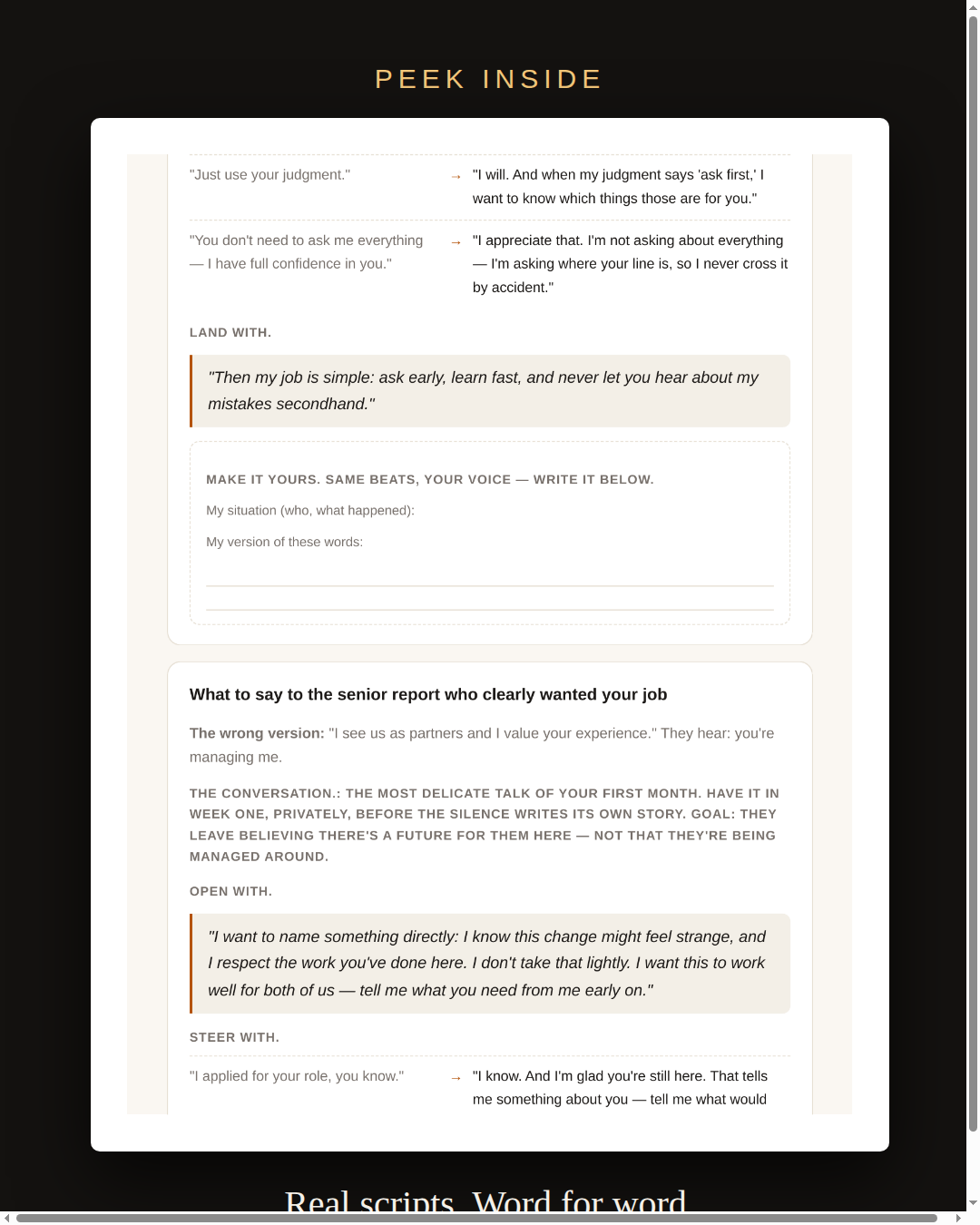
Peek inside the book
People keep telling you it’s simple: just be direct. You know it’s not that simple. The problem isn’t that you don’t know the issue — you could describe it in your sleep. The problem is the words won’t come when it counts. The meeting starts, their face changes, and the opener you rehearsed in the car dissolves into something softer, vaguer, more corporate — or nothing at all.
You’ve had this conversation forty times in your head. Zero times out loud. That gap — between the manager you are in the shower and the one you are in the room — is the whole problem. It’s also the whole book.
161 scripts · 17 chapters · The full book, not a sample.
If one of those days is yours, keep reading. You already know which one.
Advice tells you to be direct. This hands you the direct sentence — and the one for when they push back, go silent, or start to cry.
Instant access. Download the PDF, open it on your phone in the parking lot, and walk in with the words.
$27 · Instant access · PDF opens on any device
Before you buy anything
This is the complete “When someone cries” script, exactly as it appears in the book — nothing held back. It happens in every manager’s first year: the feedback lands wrong, the eyes fill, and suddenly you’re managing tears instead of the problem. Use this in your next 1:1. It’s yours whether or not you ever buy the book.
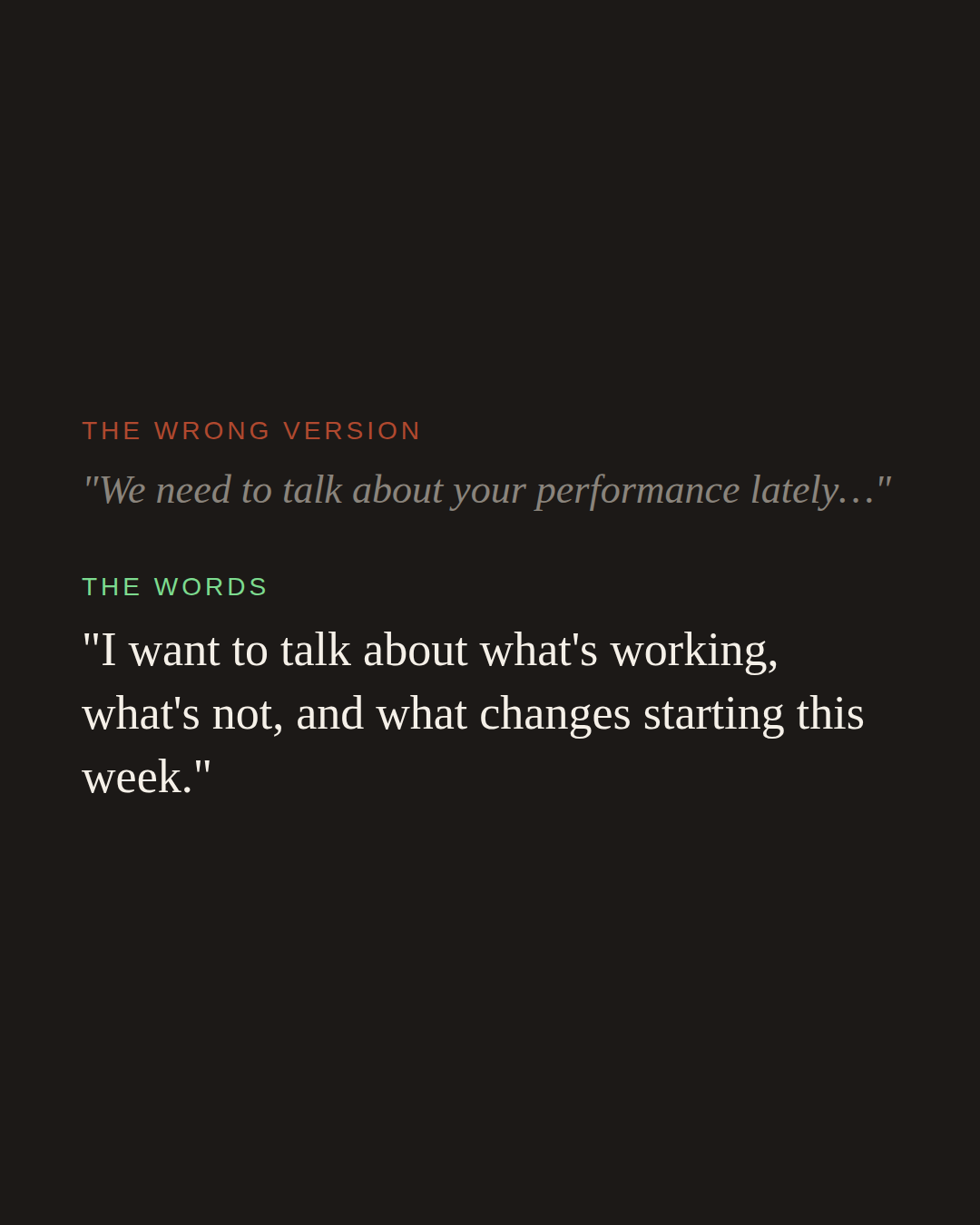
The wrong version
“Oh no, I’m so sorry — we don’t have to talk about this, let’s just move on —”
That’s panic with punctuation. Now they’re managing your feelings instead of their own.
The moment
This usually lands in a 1:1 — sometimes in a meeting. Your job is the opposite of fixing: hold the room steady while they come back to you. They should leave knowing the tears didn’t cost them anything.
Open with
“Take your time. There’s no rush.”
“You don’t have to be fine in here. Tell me what’s going on.”
Steer with
They say: “I’m sorry, this is so unprofessional.”
“It’s not. You’re a person having a week. I’m not grading you on this.”
They apologize again and keep crying.
“No apology needed. Take the time you need.”
They say: “Can we just move on?”
“We can. But the door stays open — today, next week, whenever. No expiration date on this.”
They tell you what’s going on, then go quiet.
“Thank you for trusting me with that. What would help most right now — keep talking, or sit with it?”
Land with
“You don’t have to be fine in here — not today, not ever. We’ll pick this up whenever you’re ready.”
That’s one script. There are 160 more — including the one for the meeting you’re actually dreading.
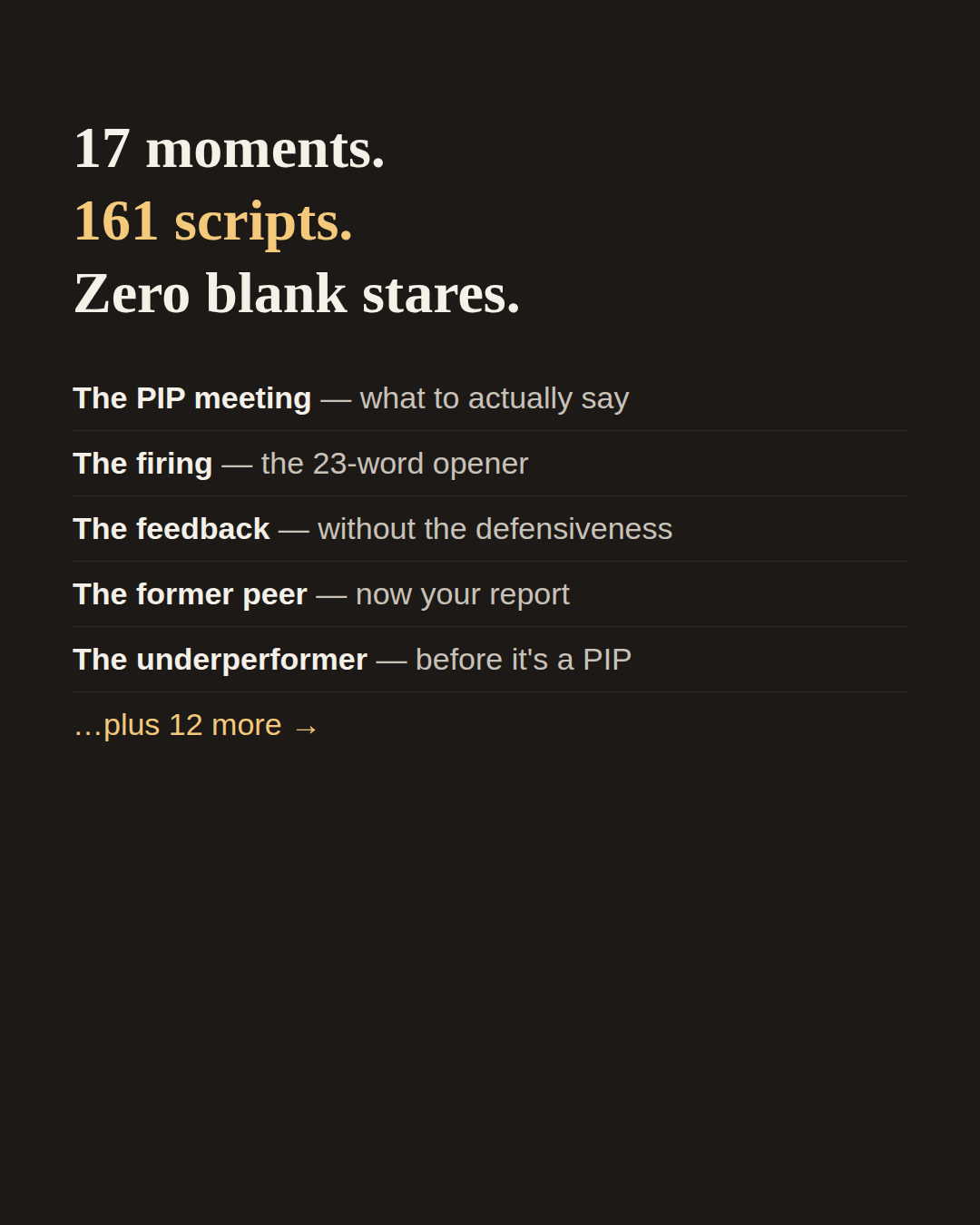
The 17 moments
Every manager is carrying one conversation. It’s in here — they all are. These aren’t topics; this is the actual chapter list. Check it against your week.
You found yours just now, in about four seconds. That one has a chapter, an opener, a pushback line, and a close.
Rehearsing openers in the shower.
Postponing the meeting.
Softening the message until it means nothing.
Lying awake replaying what they should have said.
Opens with the sentence — not an apology for having it.
Says the hard part in the first minute, while it can still help.
Knows what to do with the silence after.
Sleeps. The conversation is over, not postponed.
The difference isn’t confidence. It’s preparation you can hold in your hands.
Who wrote this
I’ve spent 15+ years leading operations and client-success teams — up to Senior Director of Operations — and I’ve frozen mid-sentence in rooms that mattered. I’ve softened feedback until it meant nothing, then replayed the drive home. I’ve done the shower rehearsals this page describes, because I lived them first.
Across those years I’ve conducted 100+ interviews and hired 25+ team members — and sat on the other side of every conversation in this book: the PIP, the firing, the layoff, the raise I couldn’t give. These scripts aren’t theory from a course. They’re the sentences I went back and built after the rooms that went sideways.
No guru. No mountaintop. A manager, writing for managers — including the chapter I needed in my own first year and couldn’t find anywhere.
The issue you’re not naming compounds — quietly, every week you don’t say it. Small becomes pattern. Pattern becomes their story about you — the manager who knew, and said nothing.
The one you finally have in month three is uglier than the one you could have had in week one. Delay doesn’t soften it; it stacks it — more history, more witnesses, more resentment in the room before you’ve said a word.
They watch you not say it. Then they stop bringing you things — and that quiet isn’t peace. That’s the scoreboard. Every manager learns this the hard way, or learns it here.
Inside the book, free: the 10-Minute Rehearsal Sheet. Write the polished wrong version, name what it’s protecting, then write the honest one. Your shaky first attempt happens on paper, alone — so the person across the desk gets the steady version instead.
No. Managing Is Hard is the before, the after, and the 2 a.m. — the emotional weight of the job. Panic into Poise is the ninety seconds inside the room: the exact words. They pair; they aren’t the same.
Every script ends with Make It Yours — fill-in lines that put the beats in your voice and cut any word you’d never say. The structure comes from the bank; the voice stays yours.
Because the tears are one moment of seventeen. The firing is its own chapter. So is the layoff, the PIP, the raise you can’t give, and the apology you owe. You just used the format once — the book is the other 160, there at 2 a.m. when the next one lands on your calendar.
The moments in this book don’t retire after year one — PIPs, layoffs, raises and former peers show up at every level. If the words still go missing under pressure, it’s for you.
Then the guarantee below applies. Use the scripts in a real conversation; if they don’t make you steadier in the room, you don’t pay for them.
Use the scripts in your next hard conversation. If they don’t help — if you don’t walk out feeling steadier and clearer than you walked in — email us within 30 days for a full refund. No questions, no forms, no hard feelings.
Turn my panic into poise →$27 · Instant access · PDF opens on any device
She’s already planning her week. He’s already in the group chat. The meeting is already on your calendar — the only thing that isn’t ready is the first sentence. There’s no countdown on this page; there’s already one on your calendar.
You can walk in rehearsing and hoping — or walk in with the words.
Turn my panic into poise →$27 · Instant access · PDF opens on any device